Showing posts with label storage virtualization. Show all posts

Wednesday, May 6, 2015

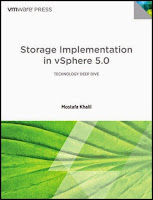
Product Highlight: Storage Implementation in vSphere 5.0

vSphere Storage Guide

When you’re working with the VMware infrastructure, you want to make sure that you have the right kind of storage implementations in place. Avoid the nightmare of running out of data space with the assistance of the Storage Implementation in vSphere 5.0. This vSphere storage guide is easy to read and allows you to store and manage your data efficiently on the VMware platform.

Understandable Breakdown:
When it comes to understanding every topic addressed about VMware, it can be quite challenging. Many guides can be dense and have poor structure. When writing this storage implementation guide, author Mostafa Khalil organized the topics in a way that would allow readers to understand what was being said without getting lost. His guide includes insights for better architectural design, planning and management practices, configuration details and external storage-related technologies.

Addresses Variety of FAQs:
Khalil has had many years of experience helping people troubleshoot storage problems they have had with vSphere. Through this, he effectively addresses many frequently asked questions in his writing. He combines expert guidelines as well as his experience to provide the best answers to customer problems. A few of the topics that he addresses include:

  • How do you configure storage array from "Vendor X" to support vSphere "Feature Y"?
  • How do you know you've configured it correctly?
  • What happens if you misconfigure it?
  • How can you tell from logs and other tools that you have a problem - and how do you fix it?

If you’re an IT professional looking to get the most out of storage virtualization on the VMware platform, this vSphere 5.0 guide will provide you with the insight and information you need. Gain an understanding of this topic and master storage implementation when you order this book today!

Thursday, March 19, 2015

Trending: Storage Virtualization

A continuing theme in the storage industry these days is Software-Defined-Storage (SDS). Though Software-Defined-anything is often simply a marketing label applied to anything that has software as part of the product, in the storage industry if refers to the degree to which a product truly virtualizes underlying storage capacity, performance, operations and management.

Expanding Explosion of Big Data
The onslaught of data being produced on the planet is growing larger every day. Every two years, the amount of data collected doubles. Increasing analytical sophistication plus real-time datasets from the Internet of Things will significantly add to the flood. Despite continued advances in storage density and speed, SDS solutions are desperately needed to facilitate infrastructure build-out, increase utilization and vanquish storage management complexity.

Bridging Disparate Environments
Smart SDS must grapple with heterogeneous hardware and software configurations, including the challenge of spanning on-site and public clouds seamlessly. Consistent, less complex storage interfaces promise to converge the underlying disparities in devices, interconnects and even geographic location; which will in turn simplify the application of enterprise IT policies.

Virtual SANs
A significant step toward solving such problems, represented by VMware’s recent release of vSAN software and their upcoming release of VVOL, is to inject change into the underlying paradigm in storage virtualization’s interaction with VMs.

Instead of the VM essentially inheriting low-level properties of the storage array, such as LUNs and NAS mount points, the VM allocates its own storage object that abstracts away those finer points. Via VMware vStorage APIs, VAAI and VASA, the VM interacts with the storage system directly. The storage unit from the VM side is not a LUN but a storage container complete with metadata, services and data store.

Hyperscale Storage
Another approach to improving cost and performance of storage virtualization is the software-centric Open Compute Project, whose aim is to eliminate proprietary, all-in-one server technology whose cost scales poorly in massive data centers, such as those run by Google, Facebook and Yahoo. The server hardware is disaggregated, simplified, standardized and controlled by license-free software where most of the intelligence resides.

Rather than single units of storage being shared by multiple VMs, both bottom-tier conventional bulk storage and top-tier flash storage reside in the same server cluster, which are shared amongst the micro-server components. The whole thing is held together, abstracted and managed by the top software layer for the rack.

Hard Technology Developments
Software-defined anything requires cheaper, faster, more intelligent hardware beneath it in order to drive advances higher in the stack. Solid state and hybrid storage are enabled by All-Flash-Arrays and Software-enhanced Flash Cache for the highest performance tier.

These, along with inline data reduction capabilities, are boosting storage server performance to new levels while simplifying load management. Higher speed interconnects and remote direct memory access network protocols further support wide-area storage virtualization and advanced computational models.

Poised on the Cusp of Change
All in all, the storage industry appears to be approaching an historical inflection point as true software defined storage emerges and storage, compute and networking capabilities reach new heights in performance and scale.